 Label IT® reagents are available in several formats, which provides researchers with a variety of options for their nucleic acid labeling experiments. In this Tip, we cover the difference between the four formats of Label IT® kits and provide guidance on which to choose for a given application.
The four formats of Label IT® kits are:
(1) Label IT® Nucleic Acid Labeling Kits
(2) Label IT® Tracker™ Intracellular Nucleic Acid Localization Kits
(3) Label IT® siRNA Tracker™ Intracellular Localization Kits
(4) Label IT® Nucleic Acid Modifying Kits
Key differences between Label IT® Kits
The table below summarizes key features of each kit format.

NOTE: the Label IT® reagent (µl):nucleic acid (µg) ratio (v:w) listed in the table is the recommended starting value prescribed in each kit’s respective protocol. Using this starting ratio in a standard Label IT® labeling reaction (37°C, 1 hour incubation), one can expect to achieve the labeling density listed in the table above. Importantly, the labeling density can easily be adjusted by scaling the ratio and/or the reaction time. Please reference the page “Adjust Labeling Density Using Label IT® Reagents” for more information on this topic.
The Label IT® Tracker™ and siRNA Tracker™ kits are optimized labeling kits for in vitro and in vivo tracking of plasmid and siRNA, respectively. That is, using each kit’s respective protocol will result in a labeling density that does not interfere with gene expression and knockdown studies. Because the labeling density can be easily adjusted with slight protocol modifications, the resultant labeling density may not be the key consideration when choosing a Label IT® kit.
Instead, one might choose to use the Label IT® Nucleic Acid Labeling or Modifying kits if the fluorophore or label of interest is unavailable in the Tracker™ formats. In addition to Cy®3, Cy®5, fluorescein, CX-Rhodamine, TM-Rhodamine and biotin reagents, the Label IT® Nucleic Acid Labeling Kits are also available with MFP488, digoxin and DNP reagents. The Label IT® Nucleic Acid Modifying Kits include the Label IT® Amine Reagent, which attaches amine functional groups to nucleic acids; once labeled, nucleic acids can be further coupled to NH2 reactive substrates or chemicals.
Lastly, the Label IT® Nucleic Acid Labeling and Modifying kits include a few extra components compared to the Tracker™ kits: Denaturation Reagent D1, Neutralization Buffer N1 and G50 microspin purification columns. The Denaturation Reagent D1 and Neutralization Buffer N1 are primarily used for hybridization experiments (see Page 6 of the Label IT® Nucleic Acid Labeling Kit Full Protocol (PDF)). The G50 microspin purification columns are used to purify labeled nucleic acids from excess Label IT® reagents after the Label IT® reaction. Purification can also be performed with ethanol precipitation, which is described step-by-step in the protocols for all Label IT® kits.
In conclusion, we recommend using the Label IT® Tracker™ and siRNA Tracker™ kits for performing standard gene expression and knockdown studies. We recommend using the Label IT® Nucleic Acid Labeling and Modifying kits if requiring a fluorophore or label that is unavailable in the Tracker™ formats and/or if the extra components (Denaturation Reagent D1, Neutralization Buffer N1 and G50 microspin purification columns) are required.
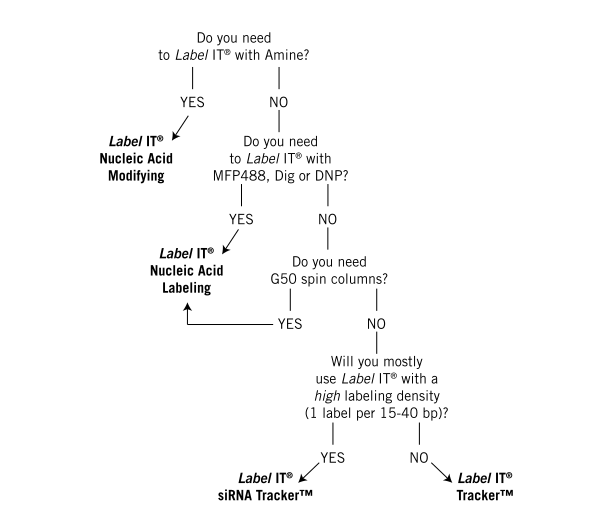
Still unsure of which Label IT® kit to use? Try out the Decision Tree below or contact techsupport@mirusbio.com for guidance.
Decision Tree for Selecting a Label IT® Kit
Start at the top and answer YES or NO until you reach a Label IT® Kit.