Description
- Broad Spectrum DNA Delivery – Utilize one transfection reagent and protocol for a variety of cells
- Low Cellular Toxicity – Maintain cell density and reduce experimental biases Learn more >>
- High Efficiency Delivery – Achieve expression in a large population of cells for experimental success
- Deliver Single or Multiple Plasmids – Suitable for applications such as virus production
SKU: MIR 2306
Supporting Data
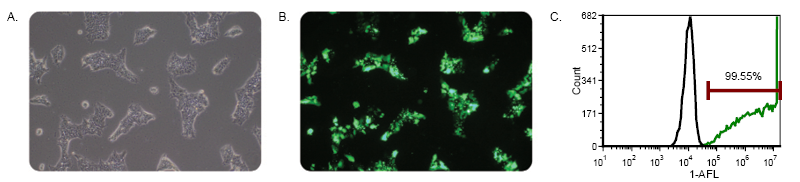
Exceptional Transfection Efficiency in Human Induced Pluripotent Stem Cells (iPSCs) via Reverse Transfection with TransIT®-LT1. The TransIT®-LT1 Transfection Reagent was used to reverse transfect 1.3 x 10⁶ iPS cells with a ZsGreen expressing plasmid (Clontech). Reverse transfections were performed in 6-well plates using 12 µl of TransIT®-LT1 Transfection Reagent to deliver 4 µg of DNA (3:1, reagent: DNA). Cells were visualized 48 hours post-transfection and imaged under a 10X objective with an Olympus IX71® Inverted Microscope. Images are (A) phase contrast and (B) green fluorescence. Cells were assayed 48 hours post-transfection on an Accuri® Cytometer. The histogram (C) shows untransfected cells (black line) compared to cells transfected with plasmid using TransIT®-LT1 (green line). See more information on stem cell applications.
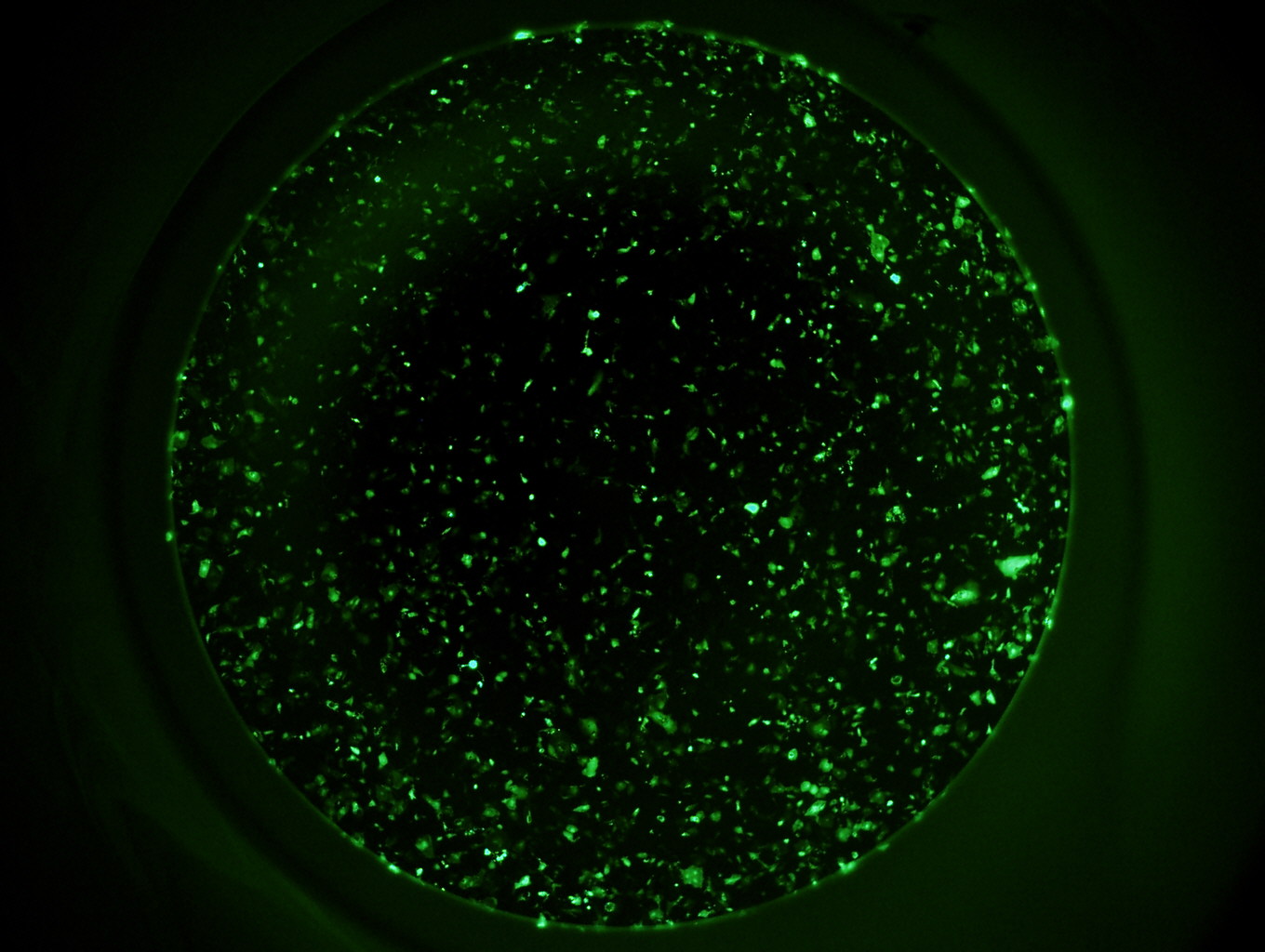
High Efficiency Transfection of iCell® Cardiomyocytes Using TransIT®-LT1 Transfection Reagent. iCell® Cardiomyocytes were plated at 20,000 cells/well in a 96 well tissue culture plate coated with 0.1% gelatin. After allowing the cells to recover from thaw, cells were transfected with 100 ng/well of pMAXGFP (Lonza) using TransIT®-LT1 Transfection Reagent with a 2:1 reagent-to-DNA ratio according to the manufacturer’s instructions. Fluorescent images were taken 3 days post transfection using a Olympus IX71® inverted microscope. See more information on stem cell applications.
Data courtesy of

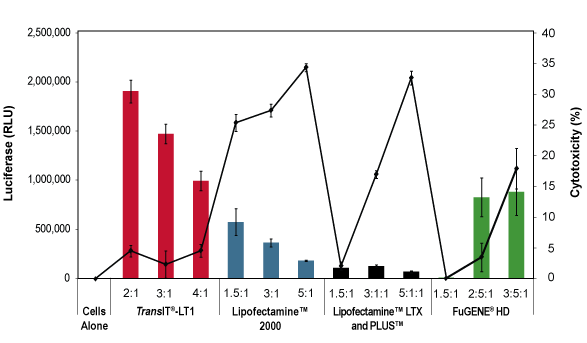
The TransIT®-LT1 Reagent Exhibits Higher Expression and Lower Cellular Toxicity Compared to Other Transfection Reagents. HepG2 cells were transfected with a luciferase expression plasmid using the designated reagents at the manufacturer’s recommended reagent-to-DNA ratio indicated beneath each bar. Transfections were performed in 96-well plates using 0.1 µg of plasmid DNA per well. Luciferase expression (bar graph) and lactate dehydrogenase (LDH) levels (line graph) were measured at 24 hours post-transfection. LDH levels are reported as % cytotoxicity compared to cells alone and were measured using a commercially available colorimetric assay; all values at or below zero are represented as zero on graph. Experiments were performed as per industry accepted testing protocols. FuGENE® is a registered trademark of Fugent LLC. Lipofectamine® is a trademark of Life Technologies Corporation.
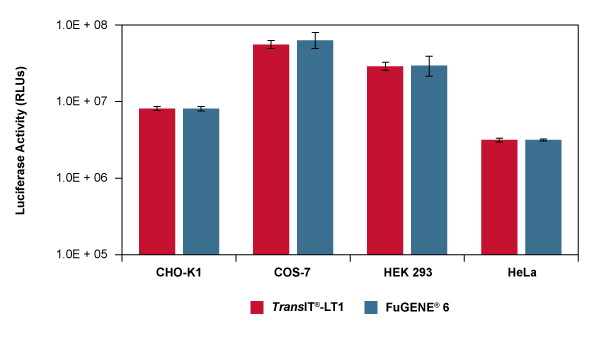
Comparable Luciferase Expression with the TransIT®-LT1 Reagent and FuGENE® 6 in Multiple Cell Types. The indicated cell lines were transfected in duplicate with 1 µg of a luciferase expression vector per well of a 12-well plate using either 3 µl of the TransIT®-LT1 or FuGENE® 6 Reagents according to industry accepted testing protocols. Cells were harvested 24 hours post-transfection and assayed for luciferase activity. FuGENE® is a registered trademark of Fugent LLC.
Resources
Specifications
Storage Conditions
All Configurations: Store at 4°C
Product Guarantee
All Configurations: 1 year
Usage Statement
All Configurations: For Research Use Only.
Animal Origin Statement
All Configurations: This product contains raw materials that are derived from animals.
Technical Product Literature
Full Protocol
TransIT®-LT1 Full Transfection Protocol (PDF)
Additional Protocol
TransIT®-LT1 for iPSC Reverse Transfection (PDF)
Quick Reference Protocol
TransIT®-LT1 Quick Ref Protocol (PDF)
Optimization Protocols
Optimization Protocol for DNA Transfection (PDF)
Video Protocol
Watch Video Protocol
Additional Resources
Why compromise your transfection results with toxicity?
Stem cell applications
Protocol: Reverse Transfection of Human Induced Pluripotent Stem (iPS) Cells with TransIT®-LT1 Transfection Reagent (PDF)
FAQs
See the TransIT-LT1 FAQs